
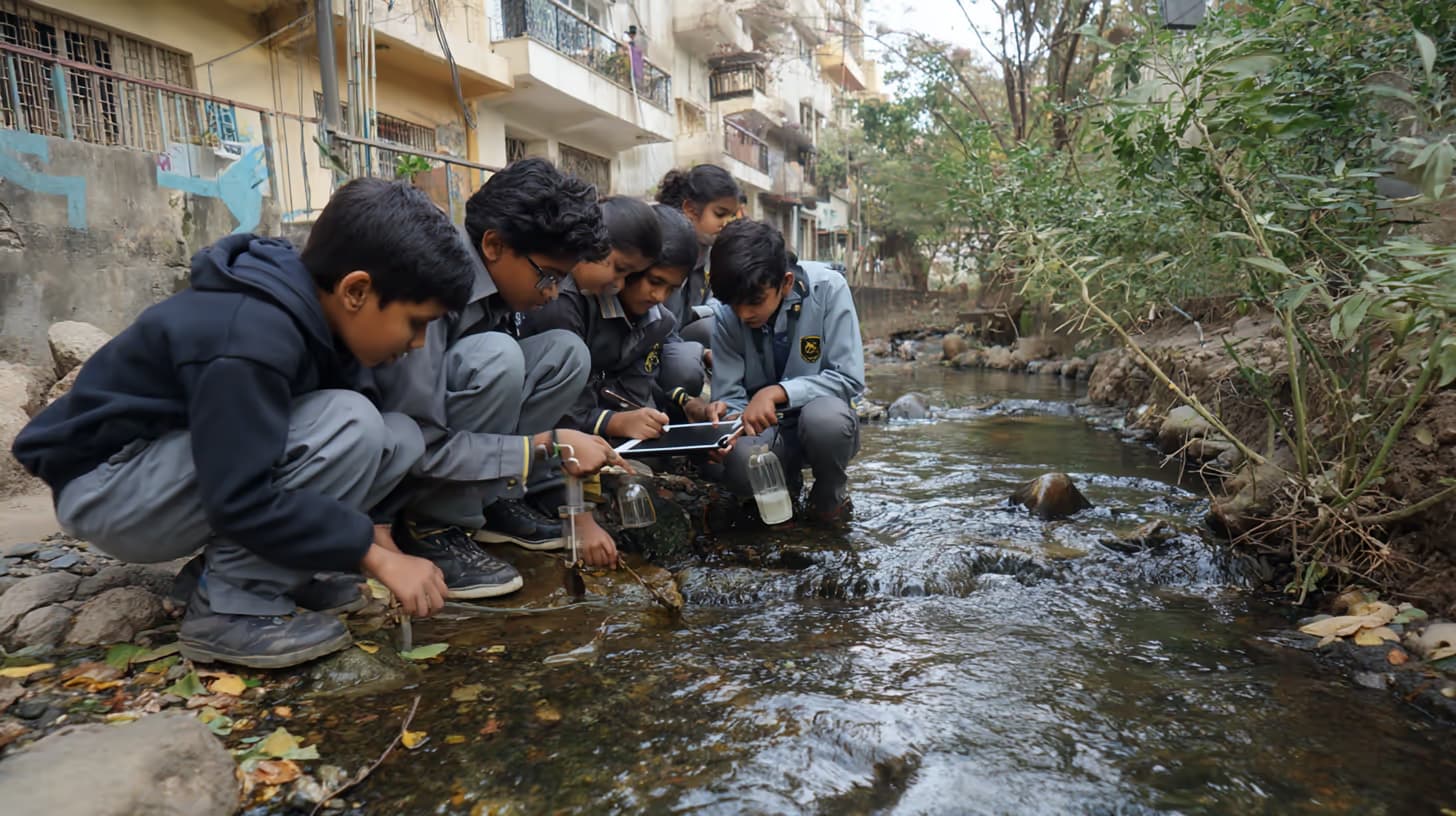
Coding for Clean Water
In southern India's Coimbatore district, middle-school students noticed that their neighborhood stream smelled strange. Instead of waiting for adults to act, they designed an app. Guided by a local STEM mentor, the students built a low-cost water-quality sensor using open-source code and recycled materials. They collected daily readings of pH and turbidity, then plotted them in a simple line chart. When the class presented their findings to the city's sanitation board, it triggered cleanup measures and a new community reporting system. Their small chart spoke a large truth: children's code cleaned a city's conscience.
Human Impact
Within months, residents saw improvement in water clarity and odor. Students who once viewed science as abstract began leading neighborhood data drives. Parents learned to read pH charts taped outside classrooms. The project seeded a new expectation: if we can measure it, we can mend it.
What Went Right
Understanding the key factors that led to success helps us replicate these positive outcomes in other contexts.
Local Relevance: The data came from the students' own streets — authenticity bred commitment.
Accessible Technology: Using inexpensive sensors and open data platforms made replication possible across schools.
Community Partnership: Officials recognized the precision of the student data and invited them to co-design updates to the city's monitoring plan.
Ethical Scaling: Teachers framed the work around fairness — ensuring that every neighborhood, not just wealthier ones, had its water tested.
Ethical Reflection
Data succeeds when it returns power to the people who live with its consequences. Accuracy without empathy is extraction; empathy with evidence is transformation. When students become both witnesses and stewards, science becomes service.
Chart-Ed Connection
This case bridges DLL 3 (Creating and Communicating with Data) and DLL 10 (Applying Data Ethically in Context). It demonstrates how simple representation skills evolve into ethical application — how a child's pictograph matures into a community dashboard. The same line that tracks pH levels becomes the line that connects learning to leadership.
Design & Act
Invite students to map a local environmental concern—air quality, noise, litter, school energy use—and collect data for one week. How will they ensure accuracy and fairness? What chart will best communicate the story? How could their findings guide action by peers or local leaders? Encourage reflection: When does data stop being homework and start being hope?
Build Better Data Practices
The Chart-Ed Institute for Global Data Literacy provides standards and frameworks to replicate these successes.